

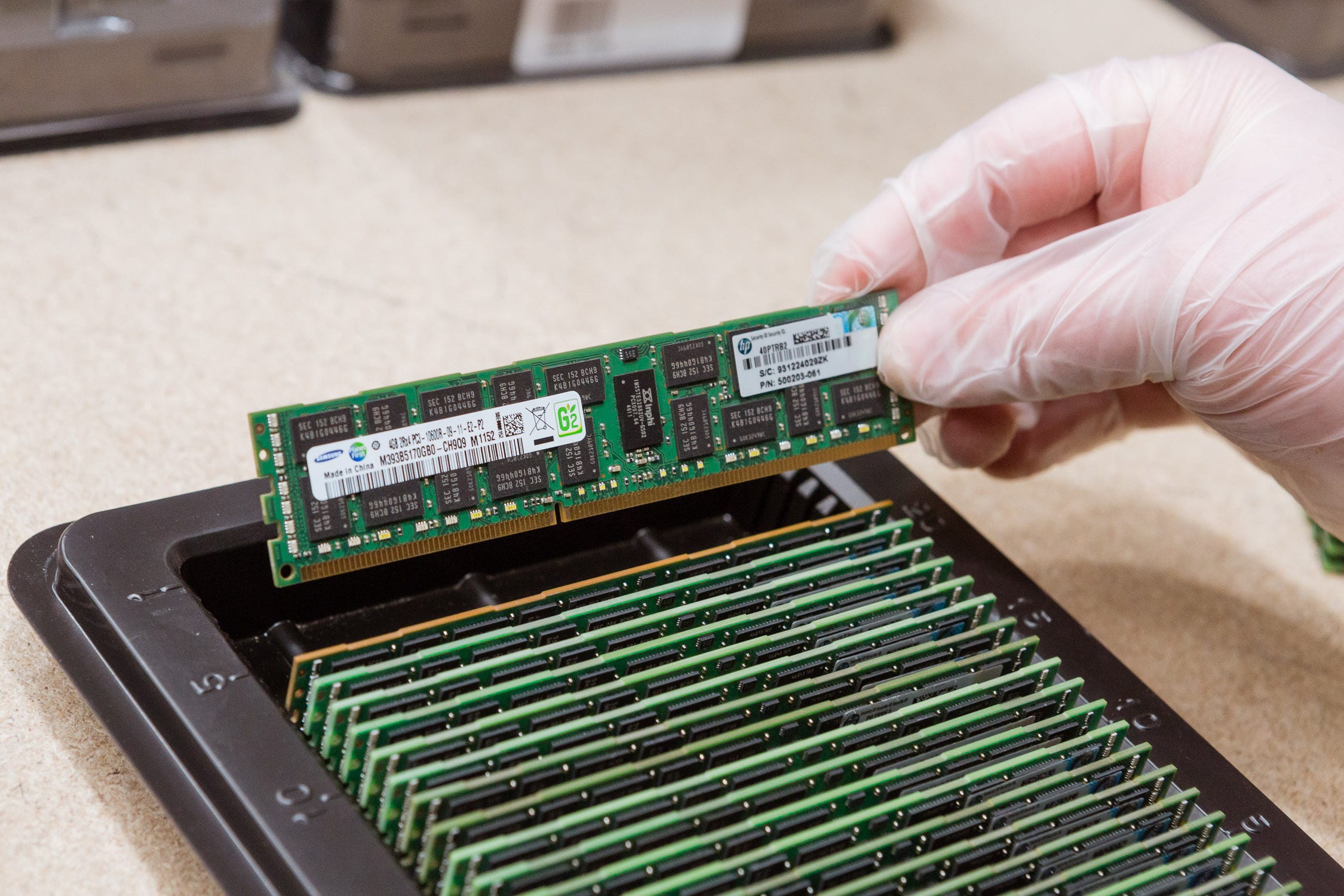
For instance, in early 2024, a 32GB DDR5-6000 kit priced around $105 was being sold at Newegg and Amazon at about $350. Such a price increase is not due to inflation. It is because the buyer profile for RAM has shifted. According to TrendForce, PC DRAM contract prices in Q1 2026 are predicted to jump over 100% quarter-on-quarter. This marks the greatest single-quarter jump ever recorded. RAM is not expensive due to a fire or a shipping delay. AI companies are buying the same silicon wafers you would use to upgrade your PC at unlimited budgets.
Memory prices are increasing because HBM (High Bandwidth Memory) required for AI data centers consumes three to four times more silicon wafer capacity than the standard DDR5 module. When Samsung and SK Hynix allocate production lines to HBM modules, the consumer memory supply decreases and prices skyrocket for all categories of RAM including gamer’s memory and notebook modules.
So, what is the reason behind the high price of RAM in 2026? The answer is quite simple – only three companies control more than 93% of the global DRAM market production capacity. All of these three firms have dedicated their highest capacity factory lines to AI-grade memory and none of them has any interest in lowering the price of memory at a time when AI companies are willing to pay 10x more for memory chips. The consumer market is just getting in the middle.
How AI Infrastructure Actually Drives Up the RAM You Buy
What does the price of RAM have to do with the server in a Microsoft data center? Well, they start at the same spot as any other product, namely a semiconductor fabrication plant. HBM is produced in the same foundries as standard consumer DDR5 by Samsung, SK Hynix, and Micron.
The only difference is that HBM is produced using a stack of memory chips via a TSV process. It consumes three to four times more wafer capacity compared to the regular DDR5 production process. In other words, every factory line allocated for the production of HBM chips leaves the consumer market with less memory supply and higher prices for everything else.
According to TrendForce’s Q3 2025 market report, the overall global DRAM revenue jumped by 30.9%. However, the increase in revenue could be attributed to nothing else but increased AI infrastructure orders at higher per-unit prices. When the average price of memory goes up, it goes up in every category.
For example, a high-performance AI GPU, such as NVIDIA H100 or H200, requires 80GB of HBM for full functionality. Just think about how many of those GPUs a single training cluster needs, and you will easily grasp the scale of the current shock affecting memory prices. Consumer DDR5 is better for gaming and general upgrades. Server-grade ECC RAM and HBM, in turn, are better for training AI. But both compete for the same manufacturing capacity.
The Three Companies That Set Your RAM Price
Together Samsung, SK Hynix, and Micron account for about 93% of the global DRAM production. Thus, you have an oligopoly that can influence the price of memory in every laptop, server, and gaming PC. As of Q3 2025, SK Hynix accounted for 34% of the global DRAM revenue market share, followed by Samsung and Micron with 33% and 26%, respectively, according to TrendForce’s statistics. Even more impressive was that SK Hynix controlled 62% of the HBM market. In other words, the company could affect the price of AI-grade memory more easily than anyone else. Thus, when it decides to prioritize HBM production and cut DDR5 production, the ripple effect reaches consumer market in about one to two quarters.
The key point is that there is no structural incentive for this oligopoly to increase the supply of consumer memory. For instance, an AI company can pay $700 per HBM4 chip while the consumer will get 32GB DDR5 module for $350. The decision to allocate production capacities is quite simple. Moreover, the Big Three companies actively decreased production capacity in 2024 with the aim to get rid of excess inventory and drive up the price. Supply discipline is a common practice.
In December 2025, Dell increased its price on PCs by 15 to 20% due to memory price increases. In January 2026, Lenovo decided to follow suit. According to TrendForce reporting, these changes in pricing were due to wholesale memory cost increases happening several months ago. Therefore, by the time the price changes happen, the shift was already well underway for at least two quarters.
HBM: The Specialized Memory Starving the Consumer Market
Understanding HBM (High Bandwidth Memory) is essential when it comes to comprehending the problem of RAM shortage. Knowing what HBM stands for, one will be able to understand what causes the price hike. HBM is a type of memory that stacks up multiple DRAM die vertically and connects them via microscopic channels named Through-Silicon Vias (TSVs). The end result is that HBM provides 10-20 times faster performance than standard DRAM while utilizing less energy. In other words, without HBM, the AI chip cannot do anything. The whole NVIDIA GPU roadmap depends on HBM.
According to Bank of America estimates, the global HBM market is forecasted to grow to $54.6 billion in 2026 at a 58% year-over-year increase rate. The market growth is solely attributable to AI accelerator demand. At the same time, SK Hynix openly states that its entire HBM production capacity in 2026 is already sold to customers with 12-month purchase agreements. The same is true about Samsung. In other words, there is no surplus HBM production capacity left for allocating it to consumer market.
Thus, HBM4 is better for training AI models while the standard DDR5 memory module is better for gaming PCs.
How Much Have RAM Prices Actually Risen, and Where Are They Going
It needs to be noted that prices in 2026 are not increasing consistently across all memory categories. Nonetheless, every kind is growing dramatically in terms of costs per component in the past 18 months.
The report published in November 2025 by TrendForce indicated that DDR5 parts rose 70% Y/Y as of Q3 2025 with some high-performance modules hitting as high as 170% growth compared to the prices of one year ago. In addition, PC DRAM contract prices in Q1 2026 were revised upward reflecting an expected 100% quarterly increase – the biggest jump in history. DDR4 has not escaped this situation either. With manufacturers cutting off production lines of this generation, the inventory of DDR4 chips is decreasing, thus driving its prices up despite its being technologically obsolete.
However, in the short term, there is not much of an upside. In accordance with information by TrendForce from January 2026, memory producers are focusing on server-related applications, implying that server-grade and AI-grade RAM will only grow in cost more rapidly compared to consumer memory types. The consequence of this development for the buyer of a 32GB gaming kit will be that prices are unlikely to fall until the end of 2026, with experts estimating 2027 or even 2028 as possible turnaround dates for the situation in terms of new fabrication capacity.
How to Get the Best Price on RAM Right Now
For users whose needs dictate a memory upgrade in the beginning of 2026, it is beneficial to acquire RAM components prior to additional contract price increases reaching retail prices. Meanwhile, buyers who are willing to postpone this decision to late 2027 will benefit from waiting and buying products in case the new fabrications in Texas and South Korea become operational due to expansion plans by Samsung and Micron.
There is no secret formula in buying memory during its shortage period. Still, there are certain strategies which can be employed by a consumer to get RAM components cheaper than through impulsive buying of retail kits at their peak price.
Perhaps, the most efficient method of purchasing is using price tracking. PCPartPicker provides email notifications when tracked memory kits become cheaper. Such moments occur regularly when the seller decides to clear existing inventories in advance of a contract price increase. Typically, a discount of 10-15% lasting 48 hours is available, while setting an alert and acting accordingly is definitely preferable to constantly checking Amazon on weekly basis.
Another option to reduce expenses significantly consists in acquiring a certified refurbished or open-box RAM from a reliable seller of Newegg or B&H Photo. Unlike storage devices, DRAM chips operate correctly or fail entirely. In this regard, there is little difference between a newly manufactured RAM kit and a certified open-box product, apart from a discount of 20-25%. The warranty coverage on such items is also equal to those offered with factory-sealed RAM.
The speed premium represents the aspect of consumer RAM prices which is currently extremely overvalued. The price difference between a kit at DDR5-6000 frequency and one at DDR5-4800 level is significant while the actual performance improvement of such a configuration would be measured in single digits. It makes sense for the average user to go for the latter item and use the saved funds elsewhere.
FAQ: Why Is RAM So Expensive in 2026
Will RAM prices drop in 2026?
Substantial price drops in 2026 seem impossible at the moment. Based on TrendForce forecasts, price increases will continue through the whole 2026 due to the steady growth of demand for AI infrastructure components as well as the migration of production to High Bandwidth Memory. However, the realistic possibility of alleviation of price pressure may arise in 2027-2028 years, when fabrication capacities in the US, South Korea, and Japan begin producing goods. But in turn, AI-infrastructure spending will have to slow, something which no analyst expects for the near future.
Why is DDR4 RAM almost as expensive as DDR5 now?
The reason why DDR4 has become so expensive recently lies in its limited supply provided by the manufacturers. While companies divert all possible manufacturing capacities into production of DDR5 and HBM chips, DDR4 inventory is shrinking and becoming scarcer, which raises its prices. According to TrendForce’s information from the beginning of 2026, DDR4 chip spot prices rose almost 172%. Consequently, the cost-advantage of DDR4 is gone at this point with DDR5 upgrade proving more affordable. Upgrading to DDR5 rather than buying DDR4 for prolonging lifespan of old platforms seems reasonable now.
How much RAM do I actually need in 2026?
Nowadays, 32GB is the minimum size of RAM for building a PC. Recent operating systems and AI-enhanced browsers and applications utilize considerable amount of memory, so 16GB becomes insufficient for working without slowing the system down. For more complex operations like video editing or 3D rendering or training AI models locally, 64GB should be taken into account. The difference between the two options has become smaller as far as price-to-size ratio is concerned, thus allowing one to choose a larger kit without overspending significantly. This memory should be purchased now to keep the system up to date until 2028 or beyond.
Is buying used RAM from eBay or Reddit a safe option right now?
Acquisition of secondhand RAM presents acceptable risk provided that several basic precautions are taken. Unlike other electronic components, DRAM chips do not deteriorate with age and hence pose no risk in this regard. The primary risks in buying used kits include possible incompatibility with the motherboard as well as limited warranties on the item itself. Thus, selecting a seller with good return policy or obtaining a product whose compatibility has been confirmed will minimize these risks. A used 32GB DDR5-5600 module from a verified supplier can save you about $80-$100.
What to Do in the Next 24 Hours
Enter PCPartPicker.com now and set a price alert for the RAM you want. Find a price point reflecting approximately 15% discount on current price levels and wait 30 to 60 days for a deal.
If you cannot afford waiting and should buy immediately, avoid going for the high-speed gaming variants (any kit above DDR5-5600), and purchase the highest-quality product available at lower speed tiers. The performance difference between such options is insignificant while price difference is quite noticeable. Therefore, $50-$100 will be saved.